
The Road Less Travelled - Rossolimo
Nicolas Rossolimo — the man who chose his own path, on and off the chessboard
Scott Peck's celebrated book The Road Less Travelled begins with a simple but profound observation: “Life is difficult.”
According to Peck, a meaningful life does not come from avoiding difficulties. It comes from confronting them with discipline, responsibility, truthfulness and courage. Few chess personalities illustrate this philosophy as vividly as Nicolas Rossolimo. Rossolimo did not follow a conventional road—neither in life nor in chess.
Born in Kiev in 1910 to a Greek father and Russian mother, he grew up in Moscow and moved to Paris in 1929. Later, he crossed the Atlantic and made New York his home. His journey took him through countries, professions and cultures before he finally established his own chess world in Greenwich Village.
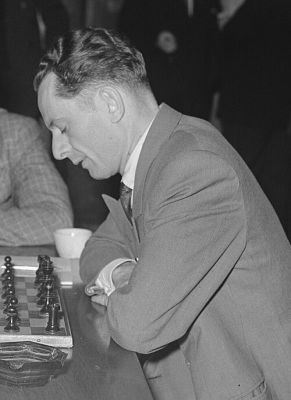
But perhaps the most fascinating part of his story is that his unconventional life and his unconventional chess seem to reflect each other.
The road less travelled in life
Rossolimo wanted to make a living from chess, but chess was not yet a financially secure profession. In Paris he drove a taxi while pursuing his chess career. After moving to the United States, he again worked as a taxi driver and also took jobs in hotels. Yet he did not abandon chess.
Instead, he eventually created the Rossolimo Chess Studio in Greenwich Village — a place where people could play chess, buy chess books and equipment, take lessons, eat, drink and meet other chess enthusiasts.
This is where Peck's idea of discipline becomes relevant.
Rossolimo's circumstances were not easy. But rather than allowing difficult circumstances to dictate the direction of his life, he continued to pursue what mattered to him. He did not have the luxury of choosing only chess. So he found a way to live with chess while doing whatever work was necessary to survive. That is very different from romanticizing hardship. It is an example of what Peck calls acceptance of responsibility.
The road less travelled on the chessboard
Rossolimo was also unconventional as a chess player. He was attracted to combinations, attacking play and beauty. He regarded chess as an art and accumulated numerous brilliancy prizes. Contemporary accounts describe his reluctance to exchange his romantic style simply for the sake of collecting points.
His famous opening system against the Sicilian Defence is perhaps the perfect symbol of this independent spirit:
1.e4 c5 2.Nf3 Nc6 3.Bb5
Today it is known as the Rossolimo Variation. The move does not plunge immediately into the enormous theoretical battles of the Open Sicilian. Instead, White chooses a different route. A different road.
The opening therefore becomes an appropriate metaphor for its inventor. When everybody else takes the well-known highway, Rossolimo looks for another road. “I will fight for the art of chess”.
Rossolimo's philosophy of chess is particularly interesting in the context of Peck's book. He apparently resisted the idea of transforming his artistic style merely to maximise results. He wanted chess to retain its beauty and creative character. This brings us to one of Peck's central ideas: Living according to your own values
For Peck, maturity involves discovering what is genuinely important and having the discipline to live according to it. Rossolimo seems to have done precisely that in chess. He could have tried to become a purely pragmatic player. Instead, he remained attracted to creativity. He did not merely ask: “What will give me the easiest point?” He also seemed to ask: “What makes this game beautiful?” That distinction is important. Discipline does not always look like discipline.
At first glance, an artistic chess player who searches for brilliant combinations may appear to be the opposite of disciplined. But Rossolimo's life suggests another interpretation. Discipline is not necessarily doing the conventional thing. Sometimes discipline means remaining faithful to something you deeply value despite pressure to conform.
Rossolimo continued composing studies, playing chess, developing ideas and creating his own chess environment. His talents extended beyond tournament chess; he was also a composer of endgame studies and had interests in music and other pursuits.
Revising the map
Another important idea in Peck's book is that every person carries a “map” of reality—and that mature people must be willing to revise that map. Rossolimo's life was almost a continuous revision of his map.
Kiev → Moscow → Paris → New York
Chess player → taxi driver → hotel worker → chess teacher → chess-studio owner
French player → American player
His identity was never confined to a single box. Perhaps that is one reason Rossolimo remains such a fascinating figure. He was not merely a chess grandmaster. He was an immigrant, artist, teacher, entrepreneur, musician and chess enthusiast who created his own environment around the game he loved.
Love as commitment
Peck's definition of love is also relevant. For him, genuine love is not merely an emotion. It is a commitment to growth. Rossolimo's relationship with chess appears to have had this quality. Chess was not merely his profession. It was something he continued to nurture, teach and share—even when the economic circumstances of professional chess made that difficult.
His Greenwich Village studio became an extension of that commitment. He did not simply play chess. He created a place where chess could live.
The paradox of the road less travelled
There is, however, an important paradox. The road less traveled is not necessarily the road to fame, wealth or conventional success. Rossolimo became a Grandmaster in 1953 and won the U.S. Open in 1955, but his financial circumstances remained difficult. So his story should not be reduced to: “Follow your passion and everything will work out.” Life is more complicated than that.
Perhaps the more realistic lesson is: Follow what matters to you—but be prepared to work, adapt and struggle along the way. That is much closer to Scott Peck's philosophy.
The final move
Rossolimo's name survives today not only because of his tournament victories but also because of a chess opening that still bears his name. The Rossolimo Variation is more than an opening. It can be viewed as a metaphor. At the critical moment, instead of automatically following the familiar path, you can choose another possibility. Not necessarily an easier possibility. Not necessarily a safer possibility. But your own possibility. That is why Nicolas Rossolimo's story fits so naturally with the title: The Road Less Travelled. He travelled a difficult road. He crossed borders. He changed professions. He struggled financially. He refused to completely abandon his artistic vision. And on the chessboard, he repeatedly searched for roads that others had not explored.
Perhaps the greatest tribute to Rossolimo is therefore not merely to say that he was a great chess player. It is to say: He played chess—and lived life—in his own way.
It is interesting to note that one of the games included in the article Scintillating Queeen Sacrifices in this bulletin has a brilliant game Rossolimo - Livingstone where Rossolimo sacrificed his queen.
—Ed